






How to Choose Ski & Snowboard Goggles
The right ski or snowboard goggle comes down to three things: a lens that suits the light you ride in, a frame that seals to your face without pressure points, and a fit that works with your helmet. Get those right and you will see more of the mountain, stay fog-free and keep your eyes protected from high-altitude UV.
Explore the Dirty Dog Snow Goggles collection to compare goggles for different light conditions, face sizes and riding styles.
Start with the Light: Lens Categories Explained
Every goggle lens has a category from 0 to 4, based on how much visible light it lets through. This is called VLT (visible light transmission). The lower the VLT, the darker the lens.
| Lens category | Light let through (VLT) | Best conditions |
|---|---|---|
| Category 0 | 80 to 100% | Night riding, very low light |
| Category 1 | 43 to 80% | Heavy cloud, snowfall, flat light |
| Category 2 | 18 to 43% | Mixed light, broken cloud |
| Category 3 | 8 to 18% | Bright sun, clear days |
| Category 4 | 3 to 8% | Extreme glare, glaciers, high altitude (not safe for driving) |
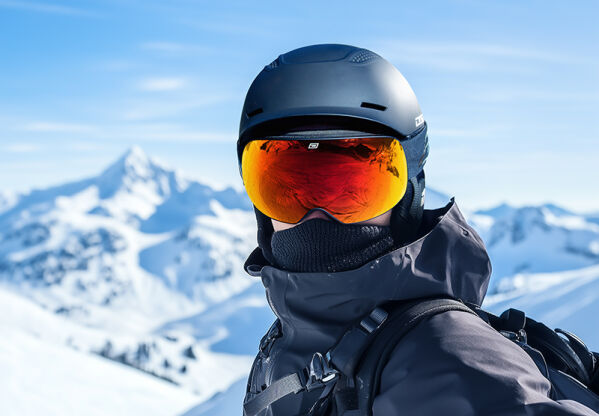
Most Dirty Dog goggles come with a category 3 mirrored lens, letting through between 8% and 17% of light. The Dirty Dog snow goggle range includes options for bright conditions and changing mountain weather. The Bullet's Grey/Red Fusion lens, for example, has a VLT of 13%. That suits the bright, high-glare days most riders get.
Choosing a Lens for Changing Light
Mountain light can change in minutes. A sunny morning can turn into flat, grey light by lunch, and flat light is where most falls and lost edges happen. You have two ways to handle it.
One Lens for Most Days
If you ride mostly in sun, a category 3 lens is the safe all-rounder. If you ride a lot in cloud or snowfall, a category 2 lens gives you a bit more light without leaving you squinting when the sun comes out. Browse the Dirty Dog Snow Goggles collection to compare available lens options.
Two Lenses, Swapped as the Light Changes
This is the better option if you ride often or in changeable weather. Carry a dark lens for sun and a light lens for flat light. Every goggle in the Dirty Dog Mutant range, including the Mutant 0.5, Mutant 2.0, Mutant Legacy, Mutant Legacy 0.5 and Mutant Oracle, has magnetic interchangeable lenses, so you can swap in seconds with gloves on.
Each one comes with a second, low-light lens in the box: a yellow lens with 76% VLT, or a rose lens with 58% VLT on some Mutant 2.0 colours. Explore the Dirty Dog Mutant 2.0 goggles or browse the full snow goggle range.
Which Tint for Flat Light?
Look for yellow, rose, amber or light pink lenses in category 1 or 2. These tints boost contrast, so you can see bumps, ruts and changes in the snow surface that a grey lens flattens out. The yellow and rose bonus lenses in the Mutant range are made for exactly these conditions. See the Dirty Dog Snow Goggles collection for available options.
Which Tint for Sunny Days?
Grey, smoke or dark mirrored lenses in category 3 cut brightness without changing colours much. Mirror coatings bounce extra glare off the front of the lens. Compare the available styles in the Dirty Dog Snow Goggles range.
Why UV Protection Matters More on the Snow
UV gets stronger as you climb, roughly 10% more for every 1,000 metres of altitude. Fresh snow then reflects up to 80% of that UV back at your eyes. That combination can sunburn the surface of the eye (snow blindness) in a single day.
Every Dirty Dog goggle lens blocks 100% of UVA, UVB and UVC, whatever its colour or category. A light flat-light lens protects your eyes just as well as a dark one.
This matters in New Zealand in particular, where UV levels are among the highest in the world. Explore the Dirty Dog Snow Goggles collection to find goggles for your next trip.
Spherical or Cylindrical Lens?
Spherical lenses curve both side to side and top to bottom, like the front of an eyeball. They give a wider field of view, less distortion at the edges, and more air space inside the goggle, which helps with fog. The Bullet, Atom, Omen, Mutant 2.0, Mutant 0.5 and Mutant Oracle all use spherical lenses. You can explore the Mutant 2.0 or compare it with other styles in the full snow goggle range.
Cylindrical lenses curve side to side but are flat top to bottom. They have a classic, flatter look and usually cost less. The Muse and Stampede Junior use cylindrical lenses, and the Mutant Legacy and Mutant Legacy 0.5 pair a cylindrical lens with magnetic lens changes.
If you want the widest view, go spherical. If you prefer the flatter look or want great value, cylindrical works well.
How to Stop Goggles Fogging
Fog forms when warm, damp air inside the goggle hits a cold lens. Dirty Dog goggles fight fog two ways: an anti-fog coating on the inside of the lens, and Custom Venting Air Flow Technology (CVAFT) that moves air across the lens to stop moisture building up.
A few habits make a big difference:
- Never wipe the inside of the lens. It damages the anti-fog coating. Shake out snow and let it air dry.
- Keep goggles on your face, not on your forehead. Body heat and sweat rising off your head fog the lens.
- Keep the vents clear of snow, and make sure your helmet or beanie is not blocking the top vents.
- Do not leave goggles in a hot car or near a heater overnight.
For goggles designed with anti-fog lens coatings and ventilation technology, browse the Dirty Dog Snow Goggles collection.
Getting the Fit Right
A good goggle seals all the way around your face with no gaps and no pressure points. Check these three things:
Face foam contact. The foam should sit evenly on your cheeks, brow and the bridge of your nose. Gaps let in cold air and snow. Dirty Dog goggles use open-cell triple foam, which moulds to your face and stays breathable.
Nose fit. You should breathe freely through your nose. Pressure on the nose usually means the frame is too big or the wrong shape for your face.
Strap. Wide, silicone-backed straps grip a helmet so the goggle does not slide. Adjust it snug, not tight.
Dirty Dog goggles come in four frame sizes. S suits smaller faces and kids, M and L suit most adults, and XL suits larger faces. Compare the available sizes in the Dirty Dog Snow Goggles collection.
Goggles and Helmets
Your goggle and helmet should meet with no gap between the top of the goggle frame and the brim of the helmet. A gap leaves a strip of forehead exposed to cold and sun, often called a “gaper gap”. Dirty Dog goggles are designed to work with all Dirty Dog helmets and most other main helmet brands. Try them on together before you buy.
For help choosing a helmet, read our ski and snowboard helmet buying guide. You can also explore the Dirty Dog Snow Helmets collection and Snow Goggles range.
Goggles for Kids
Kids need a smaller frame so the goggle seals properly. Adult goggles on a small face leave gaps and slide down. The Velocity Junior and Stampede Junior are size S frames made for children, with the same anti-fog lenses, venting and 100% UV protection as the adult range. Kids’ eyes are more sensitive to UV than adults’, so goggles or sunglasses matter even on cloudy days.
Explore the Dirty Dog Snow Goggles collection to compare the junior styles and available sizes.
Which Dirty Dog Goggle Is Right for You?
| Goggle | Size | Lens shape | Lens change | Best for |
|---|---|---|---|---|
| Mutant Legacy | XL | Cylindrical | Magnetic, bonus low-light lens | Larger faces in changeable weather |
| Mutant Legacy 0.5 | L | Cylindrical | Magnetic, bonus low-light lens | A slightly smaller fit than the Mutant Legacy |
| Mutant 2.0 | L | Spherical | Magnetic, bonus low-light lens | Changeable weather with a wider spherical view |
| Mutant Oracle | L | Spherical, frameless | Magnetic, bonus low-light lens | Changeable weather with the widest frameless view |
| Omen | L | Spherical | Fixed | All-mountain riding, great value |
| Mutant 0.5 | M | Spherical | Magnetic, bonus low-light lens | Medium faces wanting magnetic lens changes |
| Bullet | M | Spherical | Fixed | Wide view on sunny days |
| Muse | M | Cylindrical | Fixed | Style plus clear vision in mixed conditions |
| Atom | S | Spherical | Fixed | Smaller adult faces on sunny days |
| Velocity Junior | S | Spherical | Fixed | Kids |
| Stampede Junior | S | Cylindrical | Fixed | Kids |
Compare the individual styles and available options in the Dirty Dog Snow Goggles collection.
Explore Dirty Dog Snow Goggles
Once you know your preferred lens type, frame size and whether you need interchangeable lenses, compare the available goggles before choosing.
Shop all Dirty Dog Snow Goggles
Snow Goggle FAQs
What colour goggle lens is best for flat light?
Yellow, rose, amber or light pink lenses in category 1 or 2 work best in flat light. They increase contrast so you can read the snow surface when cloud removes shadows. Explore the Dirty Dog Snow Goggles collection for available lens options.
What goggle lens is best for sunny days?
A category 3 lens in grey, smoke or a dark mirror finish. For glaciers or very high altitude, a category 4 lens cuts even more glare, but never drive in one.
Do I need more than one goggle lens?
If you ride several days a season or in changeable weather, yes. A dark lens for sun and a light lens for flat light covers almost every condition. Magnetic lens goggles make swapping quick on the mountain. The Dirty Dog Mutant 2.0 is one option to consider.
Which Dirty Dog goggles come with a spare lens?
Every goggle in the Mutant range: the Mutant 0.5, Mutant 2.0, Mutant Legacy, Mutant Legacy 0.5 and Mutant Oracle. Each comes with a magnetic low-light lens (yellow or rose) as well as its main sun lens. Browse the Dirty Dog Snow Goggles range to compare the available models.
What size goggles do I need?
Match the frame to your face. Dirty Dog goggles come in S (smaller faces and kids), M, L and XL (larger faces). If the goggle presses on your nose or leaves gaps at the cheeks, try a different size.
Why do my goggles keep fogging up?
Usually because warm air from your face or forehead is trapped inside. Keep goggles on your face, keep the vents clear, and never wipe the inside of the lens, as that removes the anti-fog coating.
What is the difference between spherical and cylindrical goggles?
Spherical lenses curve in two directions for a wider view and less distortion. Cylindrical lenses curve side to side only, with a flatter look and usually a lower price.
Can I wear goggles over a helmet?
Yes. Dirty Dog goggles have wide, silicone-backed straps designed to sit over a helmet without slipping. Check there is no gap between goggle and helmet. You can compare goggles in the Dirty Dog Snow Goggles collection.
Can I wear ski goggles over glasses?
We recommend prescription inserts or contact lenses instead. They are more comfortable than wearing a goggle over glasses.
Do cheap ski goggles protect against UV?
Any goggle should state 100% UV protection, regardless of price. All Dirty Dog goggles block 100% of UVA, UVB and UVC, and lens colour has no effect on UV protection.
How do I clean my goggle lenses?
Let snow and water air dry, then dab the outside of the lens with the soft goggle bag. Avoid paper towels and never rub the inside lens.
When should I replace my goggles?
Replace them when the inside lens is scratched, the anti-fog coating has worn, or the foam no longer seals. A scratched lens scatters light and makes flat light even harder to read.
Ready to find your goggles? Browse the Dirty Dog Snow Goggles collection.
Back to Beyond the Frame